Showing posts with label ape. Show all posts
Showing posts with label ape. Show all posts
Friday, October 17, 2014
Chimp vs human! - Working Memory test
"Ayumu the chimpanzee has made headlines around the world for his ability to beat humans on memory tests, in both speed and accuracy. Does Ayumu's ability force us to reconsider our assumptions about human superiority to other primates?"
I've seen these experiments before. There are even apps where you can attempt to beat the scores and times of Chimpanzees (such as 'Ape Test'). Their cognitive abilities, i.e. 'intelligence', are clearly superior to homo sapiens in this particular area. But why? How does this ability benefit them in their natural habitat? I've yet to read of a convincing answer. As our favorite Vulcan would say, "Fascinating".


Friday, July 06, 2012
Thursday, September 13, 2007
Planet Of No Apes? Experts Warn It's Close
"Great apes have rich emotional lives and share strong family bonds. They laugh when they are tickled, cry when they grieve. They can make and use tools. They think about their past and plan for their future.
But many won't have a future to plan for, conservationists say.

The Western Gorilla - the most common gorilla in the world - is now "critically endangered," just one step away from global extinction, according to the 2007 Red List of Threatened Species released Wednesday by the World Conservation Union.
The Ebola virus is depleting populations to a point where it might become impossible for them to recover. Commercial hunting, civil unrest and habitat loss due to logging and forest clearance for palm oil plantations are compounding the problem, said the Swiss-based group, known by its acronym, IUCN.
"Great apes are our closest living relatives and very special creatures," Russ Mittermeier, head of IUCN's Primate Specialist Group, told The Associated Press. "We could fit all the remaining great apes in the world into two or three large football stadiums. There just aren't very many left.""
But many won't have a future to plan for, conservationists say.
The Western Gorilla - the most common gorilla in the world - is now "critically endangered," just one step away from global extinction, according to the 2007 Red List of Threatened Species released Wednesday by the World Conservation Union.
The Ebola virus is depleting populations to a point where it might become impossible for them to recover. Commercial hunting, civil unrest and habitat loss due to logging and forest clearance for palm oil plantations are compounding the problem, said the Swiss-based group, known by its acronym, IUCN.
"Great apes are our closest living relatives and very special creatures," Russ Mittermeier, head of IUCN's Primate Specialist Group, told The Associated Press. "We could fit all the remaining great apes in the world into two or three large football stadiums. There just aren't very many left.""
Saturday, August 04, 2007
Apes play charades to communicate
"When humans play charades, the game's ban on talk often reduces players to wild gestures in a frustratingly minimalist form of communication. Still, skillful players get the point across eventually.
Apes can't talk at all, of course. But now scientists have found that orangutans rely on the same kinds of strategies seen in charades when they try and get their point across.

The finding hints at how the earliest forms of language might have developed among humanity's ancestors.
Ape the humans
Charades involves using only body language to act out a word or phrase that others must guess. When playing charades, people often repeat and hone gestures that have already worked and abandon ones that did not. This strategy not only improves a player's chances of picking effective gestures, but also gives hints to partners on how well or poorly they are doing.
To see how capable orangutans are of communicating with people via gestures, psychologists Erica Cartmill and Richard Byrne at the University of St. Andrews in Scotland presented six adult female orangutans in zoos a chance to essentially play charades.
The apes were shown one tempting food item, such as bananas or whole-grain bread, and one not-so-tempting food item, such as celery or leeks. The food could only be reached by signaling for human help, such as by pointing with fingers, blowing a "raspberry" or spitting through the bars.
At times, the researchers purposefully misunderstood the orangutans' requests. Sometimes they provided only half of the delicious treat, while other times they handed over the unsavory alternative instead.
When people pretended not to comprehend what the apes' aims were, the creatures relied on the same basic strategy people follow in playing charades.
"The orangutans made a clear distinction between total misunderstanding, when they tended to give up on the signals they'd used already and use new, but equivalent, ones to get the idea across, and partial misunderstanding, when they tended to repeat the signals that had already partially worked, keeping at it with vigor," Cartmill said. "The response showed that the orangutan had intended a particular result, anticipated getting it and kept trying until it got the result."
Byrne noted that "looking at the tapes of the animal's responses, you can easily work out whether the orangutan thinks it has been fully, partially or not understood."
"In effect, they are passing information back to the audience about how well they are doing in understanding them — hence our 'charades' analogy," Byrne added. He and Cartmill detailed their findings Aug. 2 in the journal Current Biology.
Eager to play
Cartmill noted that the term "experiment" has gained an undeserved association with invasive or artificial studies." "The individuals I tested treated the experiment as a sort of game and eagerly approached me as I set up the equipment, hoping to succeed in winning the banana this time," she said.
Primate psychologist Anne Russon at York University in Toronto said these findings add weight "to the view that great apes—probably all of them [including orangutans]—can communicate intentionally and can do so well beyond basic levels."
Russon noted orangutans play a very important role in understanding the evolution of advanced communication because they are the "oldest" of the great apes, having diverged as a distinct species far earlier than any of the African great apes—12 to 15 million years ago versus 4 to 8 million years ago.
These findings "therefore make it very likely that the mental abilities which support this sophisticated intentional communication evolved when the earliest great apes evolved, some 12 to 15 million years ago," Russon said. "That is, they place the origins of intentional communication well prior to human evolution."
Apes can't talk at all, of course. But now scientists have found that orangutans rely on the same kinds of strategies seen in charades when they try and get their point across.
The finding hints at how the earliest forms of language might have developed among humanity's ancestors.
Ape the humans
Charades involves using only body language to act out a word or phrase that others must guess. When playing charades, people often repeat and hone gestures that have already worked and abandon ones that did not. This strategy not only improves a player's chances of picking effective gestures, but also gives hints to partners on how well or poorly they are doing.
To see how capable orangutans are of communicating with people via gestures, psychologists Erica Cartmill and Richard Byrne at the University of St. Andrews in Scotland presented six adult female orangutans in zoos a chance to essentially play charades.
The apes were shown one tempting food item, such as bananas or whole-grain bread, and one not-so-tempting food item, such as celery or leeks. The food could only be reached by signaling for human help, such as by pointing with fingers, blowing a "raspberry" or spitting through the bars.
At times, the researchers purposefully misunderstood the orangutans' requests. Sometimes they provided only half of the delicious treat, while other times they handed over the unsavory alternative instead.
When people pretended not to comprehend what the apes' aims were, the creatures relied on the same basic strategy people follow in playing charades.
"The orangutans made a clear distinction between total misunderstanding, when they tended to give up on the signals they'd used already and use new, but equivalent, ones to get the idea across, and partial misunderstanding, when they tended to repeat the signals that had already partially worked, keeping at it with vigor," Cartmill said. "The response showed that the orangutan had intended a particular result, anticipated getting it and kept trying until it got the result."
Byrne noted that "looking at the tapes of the animal's responses, you can easily work out whether the orangutan thinks it has been fully, partially or not understood."
"In effect, they are passing information back to the audience about how well they are doing in understanding them — hence our 'charades' analogy," Byrne added. He and Cartmill detailed their findings Aug. 2 in the journal Current Biology.
Eager to play
Cartmill noted that the term "experiment" has gained an undeserved association with invasive or artificial studies." "The individuals I tested treated the experiment as a sort of game and eagerly approached me as I set up the equipment, hoping to succeed in winning the banana this time," she said.
Primate psychologist Anne Russon at York University in Toronto said these findings add weight "to the view that great apes—probably all of them [including orangutans]—can communicate intentionally and can do so well beyond basic levels."
Russon noted orangutans play a very important role in understanding the evolution of advanced communication because they are the "oldest" of the great apes, having diverged as a distinct species far earlier than any of the African great apes—12 to 15 million years ago versus 4 to 8 million years ago.
These findings "therefore make it very likely that the mental abilities which support this sophisticated intentional communication evolved when the earliest great apes evolved, some 12 to 15 million years ago," Russon said. "That is, they place the origins of intentional communication well prior to human evolution."
Saturday, May 05, 2007
Activists Want Chimp Declared a 'Person'
"VIENNA, Austria (AP) - In some ways, Hiasl is like any other Viennese: He indulges a weakness for pastry, likes to paint and enjoys chilling out watching TV. But he doesn't care for coffee, and he isn't actually a person - at least not yet.
In a case that could set a global legal precedent for granting basic rights to apes, animal rights advocates are seeking to get the 26-year-old male chimpanzee legally declared a "person."

Hiasl's supporters argue he needs that status to become a legal entity that can receive donations and get a guardian to look out for his interests.
"Our main argument is that Hiasl is a person and has basic legal rights," said Eberhart Theuer, a lawyer leading the challenge on behalf of the Association Against Animal Factories, a Vienna animal rights group.
"We mean the right to life, the right to not be tortured, the right to freedom under certain conditions," Theuer said.
"We're not talking about the right to vote here."
The campaign began after the animal sanctuary where Hiasl (pronounced HEE-zul) and another chimp, Rosi, have lived for 25 years went bankrupt.
Activists want to ensure the apes don't wind up homeless if the shelter closes. Both have already suffered: They were captured as babies in Sierra Leone in 1982 and smuggled in a crate to Austria for use in pharmaceutical experiments. Customs officers intercepted the shipment and turned the chimps over to the shelter.
Their food and veterinary bills run about $6,800 a month. Donors have offered to help, but there's a catch: Under Austrian law, only a person can receive personal donations.
Organizers could set up a foundation to collect cash for Hiasl, whose life expectancy in captivity is about 60 years. But without basic rights, they contend, he could be sold to someone outside Austria, where the chimp is protected by strict animal cruelty laws.
"If we can get Hiasl declared a person, he would have the right to own property. Then, if people wanted to donate something to him, he'd have the right to receive it," said Theuer, who has vowed to take the case to the European Court of Human Rights if necessary.
Austria isn't the only country where primate rights are being debated. Spain's parliament is considering a bill that would endorse the Great Ape Project, a Seattle-based international initiative to extend "fundamental moral and legal protections" to apes.
If Hiasl gets a guardian, "it will be the first time the species barrier will have been crossed for legal 'personhood,'" said Jan Creamer, chief executive of Animal Defenders International, which is working to end the use of primates in research.
Paula Stibbe, a Briton who teaches English in Vienna, petitioned a district court to be Hiasl's legal trustee. On April 24, Judge Barbara Bart rejected her request, ruling Hiasl didn't meet two key tests: He is neither mentally impaired nor in an emergency.
Although Bart expressed concern that awarding Hiasl a guardian could create the impression that animals enjoy the same legal status as humans, she didn't rule that he could never be considered a person.
Martin Balluch, who heads the Association Against Animal Factories, has asked a federal court for a ruling on the guardianship issue.
"Chimps share 99.4 percent of their DNA with humans," he said. "OK, they're not homo sapiens. But they're obviously also not things - the only other option the law provides."
Not all Austrian animal rights activists back the legal challenge. Michael Antolini, president of the local Society for the Prevention of Cruelty to Animals, said he thinks it's absurd.
"I'm not about to make myself look like a fool" by getting involved, said Antolini, who worries that chimpanzees could gain broader rights, such as copyright protections on their photographs.
But Stibbe, who brings Hiasl sweets and yogurt and watches him draw and clown around by dressing up in knee-high rubber boots, insists he deserves more legal rights "than bricks or apples or potatoes."
"He can be very playful but also thoughtful," she said. "Being with him is like playing with someone who can't talk."
A date for the appeal hasn't been set, but Hiasl's legal team has lined up expert witnesses, including Jane Goodall, the world's foremost observer of chimpanzee behavior.
"When you see Hiasl, he really comes across as a person," Theuer said.
'He has a real personality. It strikes you immediately: This is an individual. You just have to look him in the eye to see that.'"
Visit the Great Ape Project website here.
In a case that could set a global legal precedent for granting basic rights to apes, animal rights advocates are seeking to get the 26-year-old male chimpanzee legally declared a "person."
Hiasl's supporters argue he needs that status to become a legal entity that can receive donations and get a guardian to look out for his interests.
"Our main argument is that Hiasl is a person and has basic legal rights," said Eberhart Theuer, a lawyer leading the challenge on behalf of the Association Against Animal Factories, a Vienna animal rights group.
"We mean the right to life, the right to not be tortured, the right to freedom under certain conditions," Theuer said.
"We're not talking about the right to vote here."
The campaign began after the animal sanctuary where Hiasl (pronounced HEE-zul) and another chimp, Rosi, have lived for 25 years went bankrupt.
Activists want to ensure the apes don't wind up homeless if the shelter closes. Both have already suffered: They were captured as babies in Sierra Leone in 1982 and smuggled in a crate to Austria for use in pharmaceutical experiments. Customs officers intercepted the shipment and turned the chimps over to the shelter.
Their food and veterinary bills run about $6,800 a month. Donors have offered to help, but there's a catch: Under Austrian law, only a person can receive personal donations.
Organizers could set up a foundation to collect cash for Hiasl, whose life expectancy in captivity is about 60 years. But without basic rights, they contend, he could be sold to someone outside Austria, where the chimp is protected by strict animal cruelty laws.
"If we can get Hiasl declared a person, he would have the right to own property. Then, if people wanted to donate something to him, he'd have the right to receive it," said Theuer, who has vowed to take the case to the European Court of Human Rights if necessary.
Austria isn't the only country where primate rights are being debated. Spain's parliament is considering a bill that would endorse the Great Ape Project, a Seattle-based international initiative to extend "fundamental moral and legal protections" to apes.
If Hiasl gets a guardian, "it will be the first time the species barrier will have been crossed for legal 'personhood,'" said Jan Creamer, chief executive of Animal Defenders International, which is working to end the use of primates in research.
Paula Stibbe, a Briton who teaches English in Vienna, petitioned a district court to be Hiasl's legal trustee. On April 24, Judge Barbara Bart rejected her request, ruling Hiasl didn't meet two key tests: He is neither mentally impaired nor in an emergency.
Although Bart expressed concern that awarding Hiasl a guardian could create the impression that animals enjoy the same legal status as humans, she didn't rule that he could never be considered a person.
Martin Balluch, who heads the Association Against Animal Factories, has asked a federal court for a ruling on the guardianship issue.
"Chimps share 99.4 percent of their DNA with humans," he said. "OK, they're not homo sapiens. But they're obviously also not things - the only other option the law provides."
Not all Austrian animal rights activists back the legal challenge. Michael Antolini, president of the local Society for the Prevention of Cruelty to Animals, said he thinks it's absurd.
"I'm not about to make myself look like a fool" by getting involved, said Antolini, who worries that chimpanzees could gain broader rights, such as copyright protections on their photographs.
But Stibbe, who brings Hiasl sweets and yogurt and watches him draw and clown around by dressing up in knee-high rubber boots, insists he deserves more legal rights "than bricks or apples or potatoes."
"He can be very playful but also thoughtful," she said. "Being with him is like playing with someone who can't talk."
A date for the appeal hasn't been set, but Hiasl's legal team has lined up expert witnesses, including Jane Goodall, the world's foremost observer of chimpanzee behavior.
"When you see Hiasl, he really comes across as a person," Theuer said.
'He has a real personality. It strikes you immediately: This is an individual. You just have to look him in the eye to see that.'"
Visit the Great Ape Project website here.
Sunday, February 19, 2006
Study: Cultures Affect Captive Gorillas
"Captive gorillas actually are a cultured bunch.
Genetics or environment alone cannot explain variations in the behavior of different groups of the apes, a study found.
Behavioral surveys of the roughly 370 gorillas in U.S. zoos showed 48 variations in how individual groups of the apes make signals, use tools and seek comfort, said Tara Stoinski of Zoo Atlanta and the Dian Fossey Gorilla Fund International.
'What became very obvious is there is a very distinct pattern of similarities and differences between groups,' Stoinski said.
That suggests the gorillas pass along the different traits socially, not genetically, which is a hallmark of culture. Results were presented Sunday at the annual meeting of the American Association for the Advancement of Science.
Researchers previously have found that other ape species - including chimpanzees and orangutans - show cultural differences as well in how they forage, use tools and court one another.
"These animals are smart enough to observe behaviors and imitate them," said Ingrid Porton, curator of primates at the Saint Louis Zoo.
That gorillas do the same and perhaps aren't the "slightly dumb cousins" of the ape family shouldn't be surprising, said Andrew Whiten, a professor of evolutionary and developmental psychology at the University of St. Andrews.
"It is quite surprising only if you take that common notion that gorillas aren't as smart as the rest," said Whiten, a chimp expert.
Stoinski said the surveys found that even gorillas at the same zoo but living in separate groups can display cultural differences. At Zoo Atlanta, only some gorilla groups use sticks to push aside the electrified wires that protect the trees in their enclosures, allowing the apes to snack on the bark without getting shocked, she said.
As for chimps, recent videos, described Sunday to reporters by Whiten, show the apes in the Congo using a "tool kit" to collect and eat termites.
The chimps first use a large stick to tunnel a foot deep into termite mounds. They then pull out the large stick and use a more slender piece of vegetation that they've frayed to fish out the insects through the shaft they've created, Whiten said.
Such examples of learned behaviors, when passed down from generation to generation, may have an influence on evolution, said Carel von Schaik, an orangutan expert at the University of Zurich.
"You can also argue that cultural species will become smarter species," von Schaik said."
Genetics or environment alone cannot explain variations in the behavior of different groups of the apes, a study found.
Behavioral surveys of the roughly 370 gorillas in U.S. zoos showed 48 variations in how individual groups of the apes make signals, use tools and seek comfort, said Tara Stoinski of Zoo Atlanta and the Dian Fossey Gorilla Fund International.
'What became very obvious is there is a very distinct pattern of similarities and differences between groups,' Stoinski said.
That suggests the gorillas pass along the different traits socially, not genetically, which is a hallmark of culture. Results were presented Sunday at the annual meeting of the American Association for the Advancement of Science.
Researchers previously have found that other ape species - including chimpanzees and orangutans - show cultural differences as well in how they forage, use tools and court one another.
"These animals are smart enough to observe behaviors and imitate them," said Ingrid Porton, curator of primates at the Saint Louis Zoo.
That gorillas do the same and perhaps aren't the "slightly dumb cousins" of the ape family shouldn't be surprising, said Andrew Whiten, a professor of evolutionary and developmental psychology at the University of St. Andrews.
"It is quite surprising only if you take that common notion that gorillas aren't as smart as the rest," said Whiten, a chimp expert.
Stoinski said the surveys found that even gorillas at the same zoo but living in separate groups can display cultural differences. At Zoo Atlanta, only some gorilla groups use sticks to push aside the electrified wires that protect the trees in their enclosures, allowing the apes to snack on the bark without getting shocked, she said.
As for chimps, recent videos, described Sunday to reporters by Whiten, show the apes in the Congo using a "tool kit" to collect and eat termites.
The chimps first use a large stick to tunnel a foot deep into termite mounds. They then pull out the large stick and use a more slender piece of vegetation that they've frayed to fish out the insects through the shaft they've created, Whiten said.
Such examples of learned behaviors, when passed down from generation to generation, may have an influence on evolution, said Carel von Schaik, an orangutan expert at the University of Zurich.
"You can also argue that cultural species will become smarter species," von Schaik said."
Tuesday, January 24, 2006
Chimps more like humans than apes - LiveScience - MSNBC.com
"While you might think of yourself as smarter than the average ape, beware: Those distant relatives of ours have a knack for evolving more quickly than we do. And by revealing this through DNA analysis, scientists have provided support for a controversial hypothesis that chimpanzees are more closely related to humans than to other species of great apes with which they're currently classified.

The findings were announced today in a study in the Proceedings of the National Academy of Sciences.
Researchers generally agree that humans and chimps diverged from a common ancestor about 5 million to 7 million years ago.
Chimps are lumped with gorillas and orangutans in the same family, Pongidae, whereas humans are in the family Hominidae.
But a study in 2003 found that 99.4 percent of important DNA sites are the same in chimps and humans. Other researchers have since concluded that there are crucial differences in the genetic software of the two species, however. Only a few months ago was the full chimp DNA sequence unraveled.
Chimps evolving faster
In the new study, scientists examined how quickly each species evolves. The figure they work with is called a molecular clock. It involves the rate at which DNA base pairs match up incorrectly, creating genetic errors called substitutions. These are the mutations that cause changes in a species over time.
Our clock began to slow down about 1 million years ago, and today it is 3 percent slower than that of the chimp and 11 percent slower than in the gorilla, concludes the study, led by Soojin Yi, a biologist at the Georgia Institute of Technology.
The upshot: There seem to be fewer changes to the software of life in humans over time than in chimpanzees, and even fewer still than in the other apes.
This slower clock correlates with a longer time needed to reach sexual maturity — almost twice as long for humans as gorillas. Scientists call this "generation time." In order for mutations to cause lasting change in a species, they must pass on to the next generation.
Since well before modern times, humans have taken almost twice as long to reach sexual maturity as other apes, Yi said.
"A long generation time is an important trait that separates humans from their evolutionary relatives," said Navin Elango, a graduate student working with Yi. "We used to think that apes shared one generation time, but that's not true. There's a lot more variation."
"I think we can say that this study provides further support for the hypothesis that humans and chimpanzees should be in one genus, rather than two different genus' because we not only share extremely similar genomes, we share similar generation time," Yi said.
Humans slow but smart
Given our evolutionary snail's pace, you might be wondering why, in just a few million years, we got so smart while chimps lagged.
"Even though mutations per se may arise in fewer numbers in humans than in chimpanzees, those that matter will quickly spread," Yi told LiveScience. "Mutations that are advantageous to the human, such as intelligence, probably are under strong natural selection," meaning individuals either latch on to the good stuff or perish.
However, Yi and her colleagues looked only at mutations in non-functional regions of DNA, changes that don't affect evolution. "If we looked at only those mutations that are selected, it is possible we may see different results," she said."
The findings were announced today in a study in the Proceedings of the National Academy of Sciences.
Researchers generally agree that humans and chimps diverged from a common ancestor about 5 million to 7 million years ago.
Chimps are lumped with gorillas and orangutans in the same family, Pongidae, whereas humans are in the family Hominidae.
But a study in 2003 found that 99.4 percent of important DNA sites are the same in chimps and humans. Other researchers have since concluded that there are crucial differences in the genetic software of the two species, however. Only a few months ago was the full chimp DNA sequence unraveled.
Chimps evolving faster
In the new study, scientists examined how quickly each species evolves. The figure they work with is called a molecular clock. It involves the rate at which DNA base pairs match up incorrectly, creating genetic errors called substitutions. These are the mutations that cause changes in a species over time.
Our clock began to slow down about 1 million years ago, and today it is 3 percent slower than that of the chimp and 11 percent slower than in the gorilla, concludes the study, led by Soojin Yi, a biologist at the Georgia Institute of Technology.
The upshot: There seem to be fewer changes to the software of life in humans over time than in chimpanzees, and even fewer still than in the other apes.
This slower clock correlates with a longer time needed to reach sexual maturity — almost twice as long for humans as gorillas. Scientists call this "generation time." In order for mutations to cause lasting change in a species, they must pass on to the next generation.
Since well before modern times, humans have taken almost twice as long to reach sexual maturity as other apes, Yi said.
"A long generation time is an important trait that separates humans from their evolutionary relatives," said Navin Elango, a graduate student working with Yi. "We used to think that apes shared one generation time, but that's not true. There's a lot more variation."
"I think we can say that this study provides further support for the hypothesis that humans and chimpanzees should be in one genus, rather than two different genus' because we not only share extremely similar genomes, we share similar generation time," Yi said.
Humans slow but smart
Given our evolutionary snail's pace, you might be wondering why, in just a few million years, we got so smart while chimps lagged.
"Even though mutations per se may arise in fewer numbers in humans than in chimpanzees, those that matter will quickly spread," Yi told LiveScience. "Mutations that are advantageous to the human, such as intelligence, probably are under strong natural selection," meaning individuals either latch on to the good stuff or perish.
However, Yi and her colleagues looked only at mutations in non-functional regions of DNA, changes that don't affect evolution. "If we looked at only those mutations that are selected, it is possible we may see different results," she said."
Tuesday, October 18, 2005
Tool-using gorillas intrigue scientists
It seems that scientists haven't kept up with the observed behavior of Koko, Michael and Ndume at Penny Patterson's Gorilla Foundation over the past 30 years, if they are surprised by gorilla tool use!

"GOMA, Congo - An infant gorilla in a Congo sanctuary is smashing palm nuts between two rocks to extract oil, surprising and intriguing scientists who say they have much to learn about what gorillas can do — and about the implications for evolution.It had been thought that the premeditated use of stones and sticks to accomplish a task like cracking nuts was restricted to humans and the smaller, more agile chimpanzees.
Then in late September, keepers at a Dian Fossey Gorilla Fund International sanctuary in this eastern Congo city saw 2 1/2-year-old female gorilla Itebero smashing palm nuts between rocks in the "hammer and anvil" technique, considered among the most complex tool use behaviors.
"This is a surprising finding, given what we know about tool use in gorillas," Patrick Mehlman, a primatologist for the Dian Fossey Gorilla Fund, said earlier this month at his Goma office."
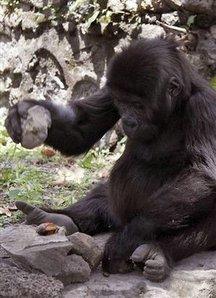
"GOMA, Congo - An infant gorilla in a Congo sanctuary is smashing palm nuts between two rocks to extract oil, surprising and intriguing scientists who say they have much to learn about what gorillas can do — and about the implications for evolution.It had been thought that the premeditated use of stones and sticks to accomplish a task like cracking nuts was restricted to humans and the smaller, more agile chimpanzees.
Then in late September, keepers at a Dian Fossey Gorilla Fund International sanctuary in this eastern Congo city saw 2 1/2-year-old female gorilla Itebero smashing palm nuts between rocks in the "hammer and anvil" technique, considered among the most complex tool use behaviors.
"This is a surprising finding, given what we know about tool use in gorillas," Patrick Mehlman, a primatologist for the Dian Fossey Gorilla Fund, said earlier this month at his Goma office."

Thursday, September 29, 2005
Biologists Observe Gorillas Using Tools
"For the first time, biologists have documented gorillas in the wild using simple tools, such as poking a stick in a swampy pool of water to check its depth.
Until now, scientists had seen gorillas use tools only in captivity. Among the great apes, tool use in the wild was thought to be a survival skill reserved for smaller chimpanzees and orangutans.
The research in the Republic of Congo's rainforests was led by Thomas Breuer of the Wildlife Conservation Society at the Bronx Zoo, which released details of his study. Breuer is in Africa and was not immediately available for an interview.
'This is a truly astounding discovery,' he said in a statement. 'Tool usage in wild apes provides us with valuable insights into the evolution of our own species and the abilities of other species.'"
Until now, scientists had seen gorillas use tools only in captivity. Among the great apes, tool use in the wild was thought to be a survival skill reserved for smaller chimpanzees and orangutans.
The research in the Republic of Congo's rainforests was led by Thomas Breuer of the Wildlife Conservation Society at the Bronx Zoo, which released details of his study. Breuer is in Africa and was not immediately available for an interview.
'This is a truly astounding discovery,' he said in a statement. 'Tool usage in wild apes provides us with valuable insights into the evolution of our own species and the abilities of other species.'"
Subscribe to:
Posts (Atom)

 Posts
Posts


