Showing posts with label gorilla. Show all posts
Showing posts with label gorilla. Show all posts
Monday, May 13, 2013


Thursday, May 20, 2010
Thursday, September 13, 2007
Planet Of No Apes? Experts Warn It's Close
"Great apes have rich emotional lives and share strong family bonds. They laugh when they are tickled, cry when they grieve. They can make and use tools. They think about their past and plan for their future.
But many won't have a future to plan for, conservationists say.

The Western Gorilla - the most common gorilla in the world - is now "critically endangered," just one step away from global extinction, according to the 2007 Red List of Threatened Species released Wednesday by the World Conservation Union.
The Ebola virus is depleting populations to a point where it might become impossible for them to recover. Commercial hunting, civil unrest and habitat loss due to logging and forest clearance for palm oil plantations are compounding the problem, said the Swiss-based group, known by its acronym, IUCN.
"Great apes are our closest living relatives and very special creatures," Russ Mittermeier, head of IUCN's Primate Specialist Group, told The Associated Press. "We could fit all the remaining great apes in the world into two or three large football stadiums. There just aren't very many left.""
But many won't have a future to plan for, conservationists say.
The Western Gorilla - the most common gorilla in the world - is now "critically endangered," just one step away from global extinction, according to the 2007 Red List of Threatened Species released Wednesday by the World Conservation Union.
The Ebola virus is depleting populations to a point where it might become impossible for them to recover. Commercial hunting, civil unrest and habitat loss due to logging and forest clearance for palm oil plantations are compounding the problem, said the Swiss-based group, known by its acronym, IUCN.
"Great apes are our closest living relatives and very special creatures," Russ Mittermeier, head of IUCN's Primate Specialist Group, told The Associated Press. "We could fit all the remaining great apes in the world into two or three large football stadiums. There just aren't very many left.""
Sunday, February 19, 2006
Study: Cultures Affect Captive Gorillas
"Captive gorillas actually are a cultured bunch.
Genetics or environment alone cannot explain variations in the behavior of different groups of the apes, a study found.
Behavioral surveys of the roughly 370 gorillas in U.S. zoos showed 48 variations in how individual groups of the apes make signals, use tools and seek comfort, said Tara Stoinski of Zoo Atlanta and the Dian Fossey Gorilla Fund International.
'What became very obvious is there is a very distinct pattern of similarities and differences between groups,' Stoinski said.
That suggests the gorillas pass along the different traits socially, not genetically, which is a hallmark of culture. Results were presented Sunday at the annual meeting of the American Association for the Advancement of Science.
Researchers previously have found that other ape species - including chimpanzees and orangutans - show cultural differences as well in how they forage, use tools and court one another.
"These animals are smart enough to observe behaviors and imitate them," said Ingrid Porton, curator of primates at the Saint Louis Zoo.
That gorillas do the same and perhaps aren't the "slightly dumb cousins" of the ape family shouldn't be surprising, said Andrew Whiten, a professor of evolutionary and developmental psychology at the University of St. Andrews.
"It is quite surprising only if you take that common notion that gorillas aren't as smart as the rest," said Whiten, a chimp expert.
Stoinski said the surveys found that even gorillas at the same zoo but living in separate groups can display cultural differences. At Zoo Atlanta, only some gorilla groups use sticks to push aside the electrified wires that protect the trees in their enclosures, allowing the apes to snack on the bark without getting shocked, she said.
As for chimps, recent videos, described Sunday to reporters by Whiten, show the apes in the Congo using a "tool kit" to collect and eat termites.
The chimps first use a large stick to tunnel a foot deep into termite mounds. They then pull out the large stick and use a more slender piece of vegetation that they've frayed to fish out the insects through the shaft they've created, Whiten said.
Such examples of learned behaviors, when passed down from generation to generation, may have an influence on evolution, said Carel von Schaik, an orangutan expert at the University of Zurich.
"You can also argue that cultural species will become smarter species," von Schaik said."
Genetics or environment alone cannot explain variations in the behavior of different groups of the apes, a study found.
Behavioral surveys of the roughly 370 gorillas in U.S. zoos showed 48 variations in how individual groups of the apes make signals, use tools and seek comfort, said Tara Stoinski of Zoo Atlanta and the Dian Fossey Gorilla Fund International.
'What became very obvious is there is a very distinct pattern of similarities and differences between groups,' Stoinski said.
That suggests the gorillas pass along the different traits socially, not genetically, which is a hallmark of culture. Results were presented Sunday at the annual meeting of the American Association for the Advancement of Science.
Researchers previously have found that other ape species - including chimpanzees and orangutans - show cultural differences as well in how they forage, use tools and court one another.
"These animals are smart enough to observe behaviors and imitate them," said Ingrid Porton, curator of primates at the Saint Louis Zoo.
That gorillas do the same and perhaps aren't the "slightly dumb cousins" of the ape family shouldn't be surprising, said Andrew Whiten, a professor of evolutionary and developmental psychology at the University of St. Andrews.
"It is quite surprising only if you take that common notion that gorillas aren't as smart as the rest," said Whiten, a chimp expert.
Stoinski said the surveys found that even gorillas at the same zoo but living in separate groups can display cultural differences. At Zoo Atlanta, only some gorilla groups use sticks to push aside the electrified wires that protect the trees in their enclosures, allowing the apes to snack on the bark without getting shocked, she said.
As for chimps, recent videos, described Sunday to reporters by Whiten, show the apes in the Congo using a "tool kit" to collect and eat termites.
The chimps first use a large stick to tunnel a foot deep into termite mounds. They then pull out the large stick and use a more slender piece of vegetation that they've frayed to fish out the insects through the shaft they've created, Whiten said.
Such examples of learned behaviors, when passed down from generation to generation, may have an influence on evolution, said Carel von Schaik, an orangutan expert at the University of Zurich.
"You can also argue that cultural species will become smarter species," von Schaik said."
Tuesday, October 18, 2005
Tool-using gorillas intrigue scientists
It seems that scientists haven't kept up with the observed behavior of Koko, Michael and Ndume at Penny Patterson's Gorilla Foundation over the past 30 years, if they are surprised by gorilla tool use!

"GOMA, Congo - An infant gorilla in a Congo sanctuary is smashing palm nuts between two rocks to extract oil, surprising and intriguing scientists who say they have much to learn about what gorillas can do — and about the implications for evolution.It had been thought that the premeditated use of stones and sticks to accomplish a task like cracking nuts was restricted to humans and the smaller, more agile chimpanzees.
Then in late September, keepers at a Dian Fossey Gorilla Fund International sanctuary in this eastern Congo city saw 2 1/2-year-old female gorilla Itebero smashing palm nuts between rocks in the "hammer and anvil" technique, considered among the most complex tool use behaviors.
"This is a surprising finding, given what we know about tool use in gorillas," Patrick Mehlman, a primatologist for the Dian Fossey Gorilla Fund, said earlier this month at his Goma office."
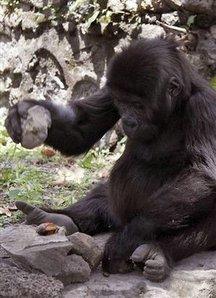
"GOMA, Congo - An infant gorilla in a Congo sanctuary is smashing palm nuts between two rocks to extract oil, surprising and intriguing scientists who say they have much to learn about what gorillas can do — and about the implications for evolution.It had been thought that the premeditated use of stones and sticks to accomplish a task like cracking nuts was restricted to humans and the smaller, more agile chimpanzees.
Then in late September, keepers at a Dian Fossey Gorilla Fund International sanctuary in this eastern Congo city saw 2 1/2-year-old female gorilla Itebero smashing palm nuts between rocks in the "hammer and anvil" technique, considered among the most complex tool use behaviors.
"This is a surprising finding, given what we know about tool use in gorillas," Patrick Mehlman, a primatologist for the Dian Fossey Gorilla Fund, said earlier this month at his Goma office."

Thursday, September 29, 2005
Biologists Observe Gorillas Using Tools
"For the first time, biologists have documented gorillas in the wild using simple tools, such as poking a stick in a swampy pool of water to check its depth.
Until now, scientists had seen gorillas use tools only in captivity. Among the great apes, tool use in the wild was thought to be a survival skill reserved for smaller chimpanzees and orangutans.
The research in the Republic of Congo's rainforests was led by Thomas Breuer of the Wildlife Conservation Society at the Bronx Zoo, which released details of his study. Breuer is in Africa and was not immediately available for an interview.
'This is a truly astounding discovery,' he said in a statement. 'Tool usage in wild apes provides us with valuable insights into the evolution of our own species and the abilities of other species.'"
Until now, scientists had seen gorillas use tools only in captivity. Among the great apes, tool use in the wild was thought to be a survival skill reserved for smaller chimpanzees and orangutans.
The research in the Republic of Congo's rainforests was led by Thomas Breuer of the Wildlife Conservation Society at the Bronx Zoo, which released details of his study. Breuer is in Africa and was not immediately available for an interview.
'This is a truly astounding discovery,' he said in a statement. 'Tool usage in wild apes provides us with valuable insights into the evolution of our own species and the abilities of other species.'"
Subscribe to:
Posts (Atom)

 Posts
Posts


